
Juan J. Duque
Cryptocurrencies are arguably one of the most popular topics of recent years. This article is an approach to them from Marxist political economy. Beyond normative positions —those that consider cryptocurrencies to contribute to socioeconomic change (whether for better or worse)—, this new type of digital money is used by a multitude of actors for various reasons. The first part presents the main technological and economic features of cryptocurrencies[1], and the second is related to geopolitics and the different actors involved in the use of privately issued cryptocurrencies. It is developed by whom and why such cryptocurrencies are used.
The term “cryptocurrency” is understood in a broad sense, as a synonym for “DLT-based money” (or potential money), that is, it includes both DLT-based CBDCs and privately issued cryptocurrencies, the latter of which contain non-pegged and pegged ones (i.e. stablecoins). That is why this text deals with “privately issued” ones, in contrast to CBDCs, that are created publicly. Many times in the literature, the term “cryptocurrencies” is used only for what are referred to here as “privately issued, non-pegged cryptocurrencies”, but in other cases —like this one— the term is generalised to reflect a common technological basis.
Distributed accounting and money
The technology behind cryptocurrencies is an evolution of accounting, enabled by an interconnected digital environment. The internet made possible a redundant and shared network; that is, a network with viewpoint-independent record of transactions shared between two or more parties in the same accounting book, the digital ledger. The importance of this is that it makes unnecessary the role of a trusted third party to guarantee transactions, having automatic clearing and settlement.
Although the internet is rife with the term “decentralised”, distribution is the defining characteristic of DLTs. The two terms are related, but, despite their vague meanings, they are far from synonymous[2]. Centralisation is quite common in cryptofinance, and much more in DLTs in general. A monetary way of understanding (de)centralisation is if new units of a currency enter circulation from a single or from multiple points[3]. It is from this perspective that decentralisation will be differentiated from distribution, understanding the latter as the previously mentioned characteristic: being a redundant and shared network. In general, immutability of movements is the most significant feature of distributed accounting compared to previous ledgers. That is, a transaction in a DLT cannot be reversed.
Regarding decentralisation, only cryptocurrencies with their own ledger can enter circulation from anywhere within it. Just native tokens, as they are often called, can enter circulation from multiple points. The other type of privately issued cryptocurrency, technologically speaking, are standardised tokens, those easily created through “smart contracts” on a DLT(s) with the standards it (they) offers. Standardised tokens are always centralised, with their supply pre-created and/or created at will by the issuer. Many native and non-pegged cryptocurrencies are also centralised, as are all stablecoins, whether native or not —stablecoins always require centralised management of some kind to maintain the peg, entering circulation from a single point. In other words, most privately issued cryptocurrencies are in fact centralised. By contrast, the most famous cryptocurrencies, BTC and ETH, are decentralised, with the DLT programmed in such a way that it offers economic incentives for validating transactions. These incentives are both fees derived from transacted tokens and also new token units, the latter being the main source of profit from “mining” or “staking”, and what makes them decentralised cryptocurrencies[4]. Any node (full or partial) of the DLT that is involved in the corresponding validating task can receive new units, so those tokens would be entering the sphere of circulation potentially anywhere in the ledger.
The fact that a cryptocurrency is more or less (de)centralised not only influences the way in which new units of the token enter the sphere of circulation, but also the greater or lesser control of the ledger by the issuer(s). When a cryptocurrency is fully centralised, the entity that controls the supply has full or very high command of the DLT, being able to pause the transactions of an account, send the tokens to non-functional accounts, and even confiscate (or stole) them; in fact being able to send the tokens to any address (or wallet) of its choice. Sometimes the degree of centralisation is less severe, and accounts can only be “frozen”. These technical characteristics regarding (de)centralisation are important for the second part of the article, as are those of distributed accounting in general —being an immutable and shared database. The question now is, are privately issued cryptocurrencies really money?
For Marx, the functions of money have a dialectical development: it begins with the primary one, measurement of value, continues with means of exchange, and then finishes with “money as money”. He subdivides the last function into hoarding or store of value, means of payment and world money, its maximum possible development[1]. Linked to the measurement of value, there is another function, unit of account or standard of prices, which is politically established[2].
Privately issued cryptocurrencies are partially developing some of the functions of money, although with particularities depending on their type, which makes them evolve in different ways based on who and for what they are created and/or used. The only type that has achieved the unit of account function is stablecoins, because they are pegged to an existing one (the US dollar, mainly). In all cryptocurrencies, and despite having partial moneyness, their most frequent uses occur in the global sphere, thus being potential world monies. This is the great peculiarity of this new type of digital money: without even having fully developed the monetary functions, it tries to achieve them directly at their maximum development.
In private cryptofinance, the functions of means of exchange and means of payment predominate in stablecoins. Non-pegged cryptocurrencies are more used as store of value —some of them also quite used for large payments—, at the same time they are attempting to measure such value. Moneyness is developing, with the significant fluctuations of non-pegged cryptocurrencies’ prices (fiat denominated) complicating such development. However, a certain stabilisation is observed as usage grows, as shown in Figure 1.
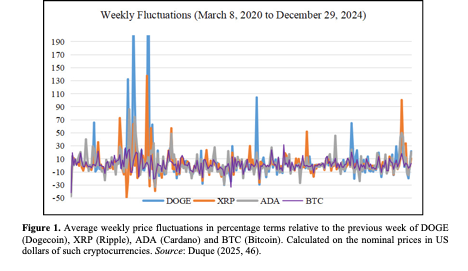
The cryptocurrencies shown in Figure 1 are considered well established and have their own DLTs, and yet considerable differences are observed, with BTC showing much smaller fluctuations. In fact, the most speculative cryptocurrencies are non-pegged standardised tokens that appear in droves, continuously registering fluctuations of several hundred or thousands of percentage points, sometimes within very short time intervals.
Finally, summarising that DLTs are shared ledger systems, viewpoint-independent records of transactions shared between different agents. They are digital and distributed databases in which tokens move, with such movements being immutable[7]. When these tokens represent (economic) value, they are cryptocurrencies[8]. They are a new type of digital money, although the monetary functions are partial and unequal depending on the type, usually occuring in the global sphere. Cryptocurrencies can be centralised or decentralised, something to keep in mind when considering the effective control of tokens, since only the latter can be truly unconfiscable —when there is no third party involved. Anyway, in private cryptofinance, financial engineering is easy and fast, which complicates confiscation in all cases. Monetarily, centralised tokens enter circulation from a single point controlled by the issuer, and decentralised ones from potentially anywhere in the ledger.
Cryptocurrencies are used everywhere, from the capitalist core to the periphery
As potential world monies not issued by any state, privately issued cryptocurrencies are being used for various reasons by a wide variety of actors all around the world, both institutional and non-institutional ones. They are frequently utilised by criminal organisations, people from countries facing sanctions or from economies with very high inflation, and groups persecuted for political and other reasons. Also, they are used by governments and public institutions, both for avoiding US-controlled payment mechanisms and to promote them. This part of the article is focused on the geopolitics of private cryptofinance, also exposing examples of cryptocurrencies’ monetary functions.
The promotion and regulation of private cryptofinance, especially of stablecoins, by the second Trump administration is the most significant event, as US global finance is hegemonic[9]. The dollar is the undisputed world money, and the promotion of dollar-pegged stablecoins is a way to strengthen it. Or to avoid its decline.
Since the beginning of his second term, Trump has been encouraging and doing business with private cryptofinance, both from the US government and from his family. In January 2025, TRUMP, a non-pegged standardised token built on the Solana ledger, was launched. Another non-pegged cryptocurrency (WLFI) and a stablecoin (USD1) were also created and launched by World Liberty Financial, a company owned by the family of the US president and by Steve Witkoff and his family. The company presents itself as “where DeFi meets TradFi”, and the conflicts of interest are of such magnitude that the Pakistani government has just signed an agreement for its central bank to integrate USD1 into a regulated financial mechanism for cross-border payments[10]. Furthermore, Trump’s announcements of policies on private cryptofinance regulation and on tariffs have coincided with financial movements that have reaped billions of dollars in profits. The blatant manipulation of global financial markets has been a constant since the beginning of 2025, with those around Trump fattening their fortunes. It is not that US-led capitalist trade and finance were not a fraud before, but now it seems there are teenage scammers in the White House.
Private cryptofinance was widely joined by US big banks, and also by funds and other “shadow banks”. Cryptocurrencies can now be bought and stored in almost all banks of the capitalist core, and in many of the periphery, although most do not offer a wallet with transferable tokens, but rather accounting entries in their ledgers. But the most interesting events are exchange trade funds (ETFs) and products (ETPs), and Strategy’s Bitcoin-linked financial instruments. The latter are different stocks and bonds that the US company Strategy offers, whose prices and yields depend on the huge BTC reserves that the company holds[11].
Several countries have approved and regulated ETFs or ETPs of some of the established non-pegged cryptocurrencies, sometimes of baskets combining various of them in certain proportions. For obvious reasons, the most relevant is the case of the United States and the ETFs of BTC and ETH. It is estimated that iShares Bitcoin Trust (BlackRock) hoards around 800 thousand BTC —a number similar to that of Strategy[12]—, selling shares of its own spot Bitcoin ETF (IBIT) to its customers. Like many other financial operations in capitalism, the magic of an ETF is that the buyers do not own the underlying assets, so the fund profits both with the ETF and with the assets, if it owns the latter. It may be the case that the fund does not even own the underlying asset, like happens with ETFs of agricultural commodities. By contrast, large financial institutions do tend to hoard commodities like gold, also hoarding BTC and ETH. Without a doubt, the actors mentioned until this point are the biggest bandits among all those who will be exposed in the remainder of this text.
Going now to the periphery, Iran legalised cryptocurrency mining in 2019, licensing supervised “mines”. Subsidised electricity for industrial use makes it one of the cheapest places to mine BTC in the world, with an estimated cost of around $1,300 per new token[13]. Throughout the country there is a lot of illegal mining (i.e., not registered as required by Iranian law), with a lot of the mining companies being controlled by the Revolutionary Guard, which mines BTC using electricity at production cost. Obviously, the start of the war with the US and Israel is changing all this in ways that will become clearer later in time.
Beyond BTC mining, private cryptofinance is a factor to consider in the Iranian economy. It is estimated that cryptocurrency transactions in Iran moved $8-11 billion in 2025, with around 15 million Iranians involved in some way in using cryptocurrencies[14]. With the outbreak of war, Iran has blocked the Strait of Hormuz and is designing a toll system, where payments can be made, at least, in yuan or (privately issued) cryptocurrencies. Explaining the process that oil tankers must follow if they want to cross, an Irani official says: “Once the email arrives and Iran completes its assessment, vessels are given a few seconds to pay in bitcoin, ensuring they can’t be traced or confiscated due to sanctions”[15]. Aside from BTC, which is decentralised, Iranian authorities have accepted and paid in USDT many times, trying to avoid confiscation of these stablecoins through “mixers” and other rapid financial engineering software. This has not gone well for them on many occasions, with their USDT being detected and confiscated (through Tether Limited) by order of the US and Israel, as will be explained later.
A small country like North Korea, also heavily sanctioned by core capitalist countries, has resorted to stealing cryptocurrencies to accumulate international reserves and make global payments. It is probably the only country that can be said not to be capitalist, but obviously needs to be partially connected to the world market.
Due to Western sanctions, the dollar or the euro are not viable options to pay internationally, as both the currencies and the required payment mechanisms are not accessible to North Korean institutions —although shell companies and other methods are used to buy and sell in dollars and to employ SWIFT. The country relies on historical commodity money (gold and silver), and on rubles and yuan, with barter and triangular trade being frequent. Privately issued cryptocurrencies have been incorporated into the repertoire, with the government-linked hacking group Lazarus having stolen all kinds of privately issued cryptocurrencies from various digital platforms. Although it is difficult to calculate, and prices fluctuate greatly, it is estimated that they stole $3-6 billion in crypto since 2017, highlighting the theft of almost half a million ETH from the Bybit exchange in 2025[16].
Another illustrative episode of this struggle with cryptocurrencies in which states act through their hackers is that of Cambodia’s Prince Group and the US government. The Prince Group is one of Cambodia’s largest conglomerates, involved in various legal and illegal business activities. East Asia homes numerous scam centers, particularly in Myanmar, Laos and Cambodia, often involving Chinese criminal organisations. That was the case with the Prince Group, involved in online gambling, money laundering and scams that frequently included forced labour and cryptocurrency theft[17].
Chen Zhi, the founder of Prince Group, was related to LuBian, a BTC mining pool based mainly in China and Iran. Due to an encryption that was not complex enough, US government-linked hackers obtained the private key of a LuBian’s “chain address” linked in some way to Zhi. Something over 120 thousand BTC —more than 11 billion US dollars in December, 2025— were transferred to an address where they remained untouched for 4 years, and then transferred to another one belonging to the US government. At that moment, on October 14, 2025, the United States Department of Justice issued a statement announcing charges against Chen Zhi and the “confiscation” of 127,000 BTC[18]. In January 2026, Zhi was extradited from Cambodia to China, where is pending trial.
These cases are examples of how states acquire their reserves of privately issued cryptocurrencies, an increasingly common practice. In fact, the first state reserves are linked to the first practical use of BTC. In 2011, Bitcoin’s monetary use was as means of exchange in very concrete markets. The most important one was to pay on Silk Road, a website hosted on the dark web where drugs and other illegal commodities were bought and sold[19]. Payment on the website was made with BTC and the products were shipped by mail. In October 2013, the FBI shut down Silk Road, confiscating around 144 thousand BTC from its wallets, which would become part of US state reserves. Its creator, Ross Ulbricht, was sentenced to more than two life sentences, receiving a pardon from Trump in early 2025.
China obtained its reserves in a similar way. From 2013, companies dedicated to BTC mining flourished in China, among other activities related to cryptofinance. Until authorities began to heavily regulate the sector. The first round of bans (in 2017-2018) focused on trading, and the second (in 2021) on mining. Chinese authorities have confiscated BTC from exchanges and other platforms that have failed to comply with new legislation, or that have participated in scams such as the notorious PlusToken Ponzi scheme. The actual figures are unknown, but it is estimated that Chinese state reserves are around 200 thousand BTC[20].
Regarding the everyday use of privately issued cryptocurrencies, there are two countries that have declared BTC as legal tender, El Salvador and the Central African Republic. In both cases its use among the population has been very low. In contrast, stablecoins are expanding across several countries as means of exchange and payments —they are quite used for remittances, and sometimes also for daily payments. South American countries like Venezuela, Brazil and Argentina, Asian countries like Turkey, Vietnam and Indonesia, and African countries like Nigeria stand out for the use of USDT among their populations[21]. This implies a trend toward the dollarisation of their economies, or reinforces it[22]. That is why the Trump administration is fervently promoting the creation and expansion of stablecoins, also having control over their ledgers/smart contracts.
Tether (or USDT) is in fact the most important case study after Bitcoin, involving some famous figures in contemporary geopolitics. USDT is the most used stablecoin globally, and the most utilised cryptocurrency in number of transactions. It is issued by Tether Limited, a company initially registered in the British Virgin Islands, and with its headquarters recently moved to El Salvador. It consists of standardised tokens deployed across various DLTs. The synchronisation of such tokens and the peg to the dollar are maintained through centralised management by the company.
Tether has grown to such a size that there are around 185 billion USDT in circulation[23], so it manages that amount of assets in US dollars. Most of those assets are made up of US Treasury bonds, along with repo agreements, corporate bonds, money market funds and others[24]. The most striking thing about Tether’s reserves is the large gold purchases that the company has been making in recent months, with around 140 tons of gold stored in Swiss bunkers[25].
Tether Limited has demonstrated cooperation with US authorities on multiple occasions. Such centralised control has facilitated the freezing —and many times also confiscation— of funds supposedly linked to stereotypical enemies of the United States, such as Chinese fentanyl trafficking networks, Russian oligarchs involved in oil trade with Venezuela, Hamas, and organisations from North Korea and Iran[26].
The same applies to crypto exchanges; geopolitics and power relations can be observed in their procedures. Within the sphere of influence of the United States (and Israel) are, primarily, Coinbase, Kraken and Binance. The latter was founded in China in 2017, the same year that the Asian country started banning trading with privately issued cryptocurrencies, so its founder quickly left the country. Changpeng Zhao moved his operations to countries such as Malta, Singapore and the Cayman and Seychelles Islands.
In 2021, several US institutions launched an investigation into Binance for money laundering by terrorist organisations, and for opening accounts and processing transactions for users from countries sanctioned by the US, specifically from Iran, Cuba and Syria. After three years, the company reached an agreement with the US justice system: Binance paid $4.3 billion, and Zhao paid $50 million from his personal fortune and moved to the US to serve a 4-month prison sentence. In October 2025, Trump also granted him a full and unconditional pardon, thereby eliminating federal legal culpability. Israeli authorities have also confiscated numerous cryptocurrencies from Binance since 2021. Some of these tokens, including decentralised ones, allegedly belonged to Palestinian and Lebanese armed groups, as well as to Iranian agents[27].
On the other side of global geopolitics was the recently closed Russian exchange Garantex. The exchange was accused by some European countries of storing and transacting funds from illegal activities such as drug trafficking and hacking, but mainly of being used to evade Western sanctions against Russia. Uncle Sam came to the aid by freezing all Garantex-traded USDT funds through Tether Limited[28].
In conclusion, it is clear that private cryptofinance is becoming integrated into contemporary capitalist finance, with its underpinning technology representing a development in accounting applied to money. A monetary technology that is being used and tested by peoples and states worldwide for various purposes, at a time when it seems like all is about to explode every week.
[1] This section is based on my paper “Political economy of private cryptofinance. Technology and social relations”, which is part of a special issue on digital money of The Japanese Political Economy in which 6 other authors from SPARC participated. The collective issue in question is “Digital money. New forms and old contradictions” The Japanese Political Economy 51(1-2).
[2] About distribution and decentralisation, see Paul Baran (1964) “On Distributed Communications” RAND Corp No. RM3420PR (available at https://www.rand.org/pubs/research_memoranda/RM3420.html); and Jean-Philippe Vergne (2020) “Decentralised vs. Distributed Organisation: Blockchain, Machine Learning, and the Future of the Digital Platform” Organisation Theory 1, pp. 1–26.
[3] See Costas Lapavitsas (1991) “The Theory of Credit Money: A Structural Analysis”, Science & Society, 1991, 55(3), pp. 291–322. Included in Lapavitsas (2017) Marxist Monetary Theory. Collected Papers. Leiden, Brill, pp. 23-50.
[4] For more information about the different consensus algorithms of cryptocurrencies, see Renato P. dos Santos (2020) “Consensus Algorithms: A Matter of Complexity?” In Blockchain Economics: Implications of Distributed Ledgers. Markets, Communications Networks, and Algorithmic Reality, edited by Melanie Swan, Jason Potts, Soichiro Takagi, Frank Witte, and Paolo Tasca. London, World Scientific Publishing Europe Ltd., pp. 147-170; and Ankit K. Jain, Nishant Gupta and Brij B. Gupta (2025) “A Survey on Scalable Consensus Algorithms for Blockchain Technology”, Cyber Security and Applications 3(100065).
[5] See Karl Marx ([1867] 1990). Capital.Vol. I. London, Penguin Books, pp. 188-244.
[6] See Costas Lapavitsas (2023) “The Limits of Currency Politics” European Law Open 2(3), pp. 636–653.
[7] Although there can also be DLTs without tokens, such as Hyperledger Fabric, Quorum or Corda. They are distributed and centralised networks whose (non-tokenised) data refers to shared records, contractual agreements or assets.
[9] Following the Marxist theory of value, it can be stated that tokens can also contain value when they are native, that is, when they are indispensable parts of a DLT —as the (digital) commodities that these ledgers are, the product of human labour under capitalist conditions, with use value and exchange value. For a conceptualisation of (native) cryptocurrencies as potential digital commodity money, see Juan J. Duque (2020) “State involvement in cryptocurrencies. A potential world money?” The Japanese Political Economy 46 (1), pp. 65–82; and Juan J. Duque (2025) “Political economy of private cryptofinance. Technology and social relations” The Japanese Political Economy 51(1-2), pp. 31-54.
[10] See https://www.whitehouse.gov/presidential-actions/2025/01/strengthening-american-leadership-in-digital-financial-technology/ and https://www.whitehouse.gov/fact-sheets/2025/07/fact-sheet-president-donald-j-trump-signs-genius-act-into-law/
[11] See https://www.reuters.com/business/finance/pakistan-partner-with-world-liberty-financial-dollar-linked-stablecoin-source-2026-01-14/
[12] See https://www.wsj.com/finance/investing/behind-microstrategys-bitcoin-bet-investors-who-usually-play-it-safe-0e9dfd00
[13] BlackRock and Strategy are the two largest holders of BTC in the world, second only to Satoshi Nakamoto’s dormant reserves of approximately 1.1 million BTC.
[14] See https://www.coindesk.com/business/2026/02/28/iran-conflict-throws-the-regime-s-usd7-8-billion-crypto-ecosystem-and-bitcoin-mining-network-into-spotlight and https://www.wired.me/story/irans-crypto-sector-was-a-lifeline-through-sanctions-war-could-shut-it-down
[15] See https://www.reuters.com/business/finance/irans-surging-crypto-activity-draws-us-scrutiny-2026-02-03/#:~:text=Iran’s%20crypto%20transaction%20volumes%20hit,from%20TRM%20Labs%20and%20Chainalysis.
[16] See https://www.ft.com/content/02aefac4-ea62-48db-9326-c0da373b11b8?syn-25a6b1a6=1
[17] See https://cointelegraph.com/news/lazarus-group-bybit-sony-crypto-supervillain.
[18] See https://eastasiaforum.org/2025/11/29/unravelling-prince-groups-criminal-networks-2/
[19] See https://mp.weixin.qq.com/s/vIg9N2xRy6o6EufAAv9uVA
[20] See https://www.justice.gov/usao-sdny/pr/ross-ulbricht-creator-and-owner-silk-road-website-found-guilty-manhattan-federal-court
[21] See https://bitcointreasuries.net/governments/china.
[22] See https://www.burner.pro/blog/global-stablecoin-adoption-and-the-future-of-us-payments?utm_source=chatgpt.com and https://www.reuters.com/world/africa/biggest-african-economies-lead-stablecoin-demand-growth-study-shows-2026-02-18/
[23] See Carla Coburger (2025) “The digital dollarization dilemma: Stablecoins and monetary subordination”, The Japanese Political Economy 51(1-2), pp. 133-158.
[24] See https://coinmarketcap.com/. Obviously, more than those 185 billion USDT have been issued, as these are standardised tokens of different DLTs, synchronised through mechanisms such as cross-chain bridges or other methods of “burning” USDT in one DLT and issuing it in another. Similarly, new tokens are issued and burned based on supply and demand, as well as to support arbitrage in maintaining the peg. This means that historically, many more tokens have been issued than that number, although the exact amount is unknown.
[25] This internal audit (https://assets.ctfassets.net/vyse88cgwfbl/6GbUTVK4tTYAytefu5daIi/6cac18eb4b526c9c52640a3d2bed9642/ISAE_3000R_-_Opinion_Tether_International_Financial_Figure_31-10-2025.pdf) indicates that US Treasury bonds comprised 62 percent of assets in September 2025.
[26] See https://www.bloomberg.com/news/articles/2026-01-28/tether-is-shaking-up-the-gold-market-with-massive-metal-hoard
[27] See https://www.wsj.com/finance/currencies/most-popular-cryptocurrency-keeps-showing-up-in-illicit-finance-71d32e5e, https://www.wsj.com/finance/currencies/authorities-target-russian-criminal-gangs-who-used-crypto-to-move-cash-3363311d and https://www.justice.gov/usao-dc/pr/justice-department-disrupts-hamas-terrorist-financing-scheme-through-seizure
[28] See https://www.newarab.com/news/binance-slammed-seizing-palestinian-crypto-israel
[29] See https://www.reuters.com/world/europe/russian-garantex-cryptocurrency-exchange-targeted-international-operation-us-2025-03-07/ and https://www.justice.gov/opa/pr/garantex-cryptocurrency-exchange-disrupted-international-operation