
By Dillon Maxwell
We know when wars start, but not when they will end. Every British schoolchild is told about the infamous consensus at the onset of the First World War: “It’ll be over by Christmas.” It wasn’t. And the human and capital toll weakened the British empire to an extent from which it never recovered. The sun never set on the British empire, until of course it did. Something similar may be underway with the American empire today. The Americans and Israelis have started a gratuitous war, the consequences of which are yet uncertain, although they will certainly be far reaching. This article explores the potential economic consequences of the Third Gulf War. The arguments are necessarily speculative, but they are informed by analysis and empirical observations of the present moment. For clarity, they are separated into two categories: potential disruption to product markets, to global supply chains; and shocks to the dollar-based, international financial system. Conclusions about state policy close the piece.
Supply Chains
Modern just in time production is organised through global networks, sprawling across continents and countries. These rely on advanced logistics and information technology to coordinate tight production schedules and freight transportation, reducing inventory costs and enhancing profitability. Covid exposed the extraordinary lack of redundancy in this system. As economies went into lockdown, an enormous shock reverberated around the globe: workers and consumers locked in their homes, cargo ships stuck in queues at ports, production shutdowns – the shock quickly sparked widespread supply chain disruption. What we see today is eerily familiar. In response to American and Israeli attacks, the Iranian military effectively closed the Strait of Hormuz, choking off the Persian Gulf, wherefrom flows 25% of the world’s seaborne oil and 20% of global LNG exports[1]. In oil, the initial shock to supply mirrored the shock to demand in 2020: back then, roughly 20m barrels/day worth of demand dried up; the partial closure of the strait disrupted up to 20m barrels/day of supply[2].
Figure 1
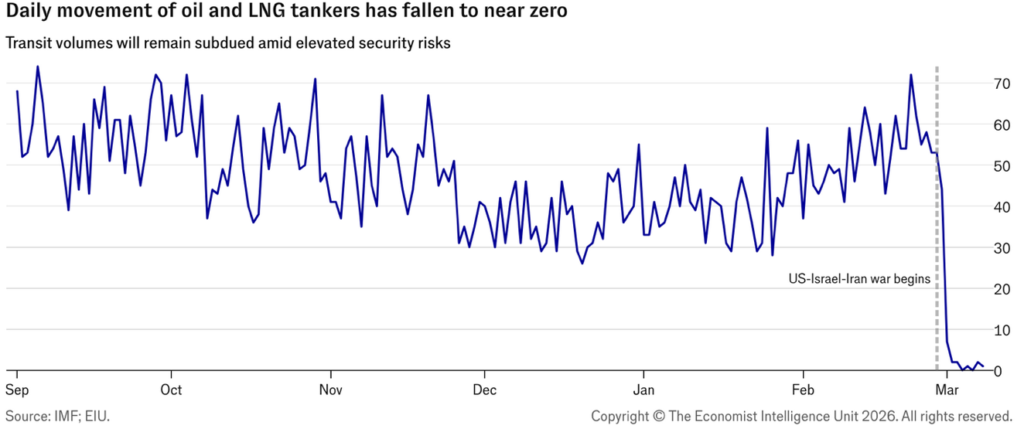
The Covid demand shock to oil markets was severe but manageable. Inventories swelled, prices collapsed, but stocks could be run down as lockdowns ended and fiscal and monetary stimulus in the global North reconstituted aggregate demand. The current supply shock is qualitatively distinct: inventories will be run down until they disappear and there’s no magic method for conjuring supply. Even if the war ends soon, oil and gas supply has already been lost. Capacity has been taken offline due to inadequate storage space, or it has been damaged by missiles and drones. Bringing this back online is not as simple as turning a tap; it takes time, realistically weeks to months[4]. And rebuilding destroyed infrastructure will take years[5].
It is an uncomfortable fact that the current oil supply shock is the largest on record[6]. Despite this, are comparisons to the 1970s energy crises alarmist? The 1973 oil embargo lasted 5 months, although the effects persisted for years; the current disruption could be shorter or longer, we simply do not know. It hinges on an unpredictable peace process. Energy efficiency, however, has clearly improved over the last fifty years; there has been a secular decline in oil dependence per unit output:
Figure 2
But these figures can be misleading. As energy efficiency per unit of output has improved and manufacturing has globalised, oil, gas, and their derivative products have become chokepoints in pivotal global production networks. Gas and oil remain essential to many electricity systems, sometimes as balancing power sources to renewables, and to industrial heating[8]; aviation and shipping fuels are irreplaceable inputs for the mass transportation of finished and intermediate goods; petrochemical feedstocks become plastics, which are ubiquitous in consumer goods; and other derivate products are essential ingredients for fertilizers, metal processing, and high-tech manufacturing[9].
To quantify the backend of this argument, Table 1 illustrates the importance of major non-energy commodities and material exports from the Persian Gulf to global production, alongside their specific uses.
Table 1: Main non-energy materials and commodities exported from the Gulf
| Commodity | Gulf share of world production | Main regional exporters | Uses |
| Ammonia and urea | 35%–45% (urea), 30% (ammonia) (of world exports) | Bahrain, Iran, Kuwait, Oman, Qatar, Saudi Arabia, UAE | Fertilizer, basic chemical input |
| Helium | 38.8% | Qatar | Chip-making, medical imaging |
| Sulphur | 21.6% (45% of exports) | Iran, Iraq, Kuwait, Oman, Qatar, Saudi Arabia, UAE | Fertilizer, mining and metals processing, uranium extraction |
| Methanol | 32%–35% (of world exports) | Bahrain, Iran, Oman, Qatar, Saudi Arabia | Fuel, basic chemical input, biodiesel manufacturing |
| Polyethylene | 15% (capacity) | Iran, Kuwait, Qatar, Saudi Arabia, UAE | Packaging, pipes, bottles, electrical insulation |
| Polypropylene | 9% (capacity) | Iran, Oman, Qatar, Saudi Arabia, UAE | Packaging, automotive manufacture, consumer goods |
| Aluminium | 9% (22% of non-China supply) | Bahrain, Oman, Qatar, Saudi Arabia, UAE | Key industrial metal |
| Phosphate | 3.9% | Saudi Arabia | Fertilizer |
To illustrate the chaos brewing in the sphere of international circulation, note that two weeks into the conflict, war risk insurance premiums for tankers in the Middle East Gulf had increased tenfold[11]. By comparison, premiums for ships transiting the red sea tripled in one week in January 2024 following the Houthi blockade[12], and oil flows through the Bab al-Mandab Strait never really recovered, despite the American-Houthi ceasefire:
Figure 3
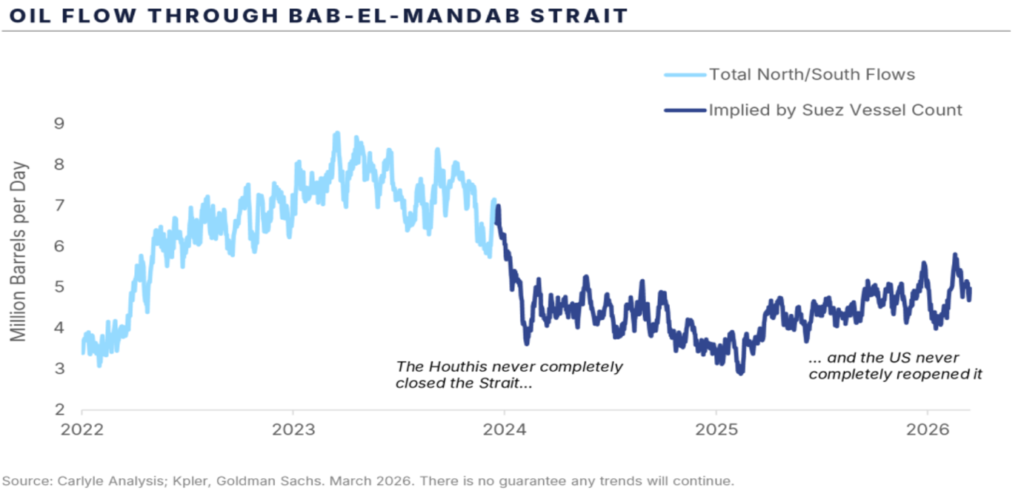
Since the Iranians have a far more sophisticated military and clearly have complete control over the Strait of Hormuz, it is reasonable to question whether goods flows through this choke point will ever recover to their pre-war levels. Tangentially, Figure 4 shows the recent shock to jet fuel prices:
Figure 4
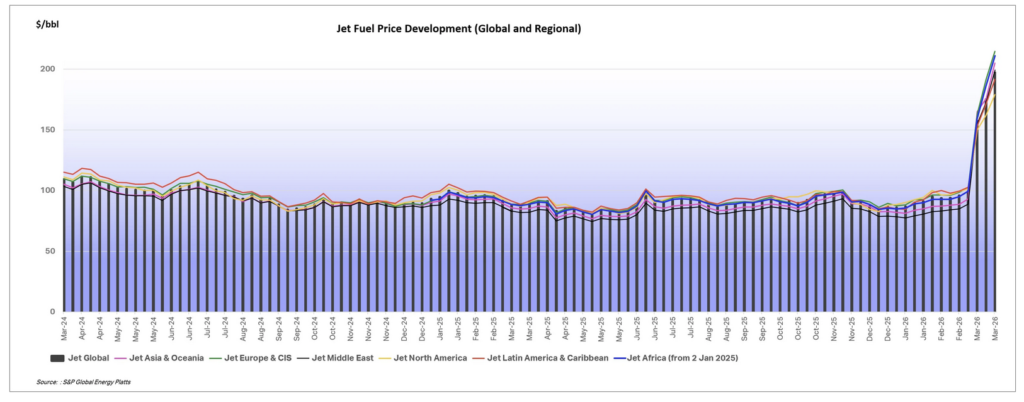
Against the background of globalisation, the scale of disruption we are facing implies more than demand destruction; we can expect production to be taken offline. It is not simply a case of reducing energy demand: of turning off the central heating or working from home and leaving the car parked outside. Aircraft without kerosene will not fly; farmers without sufficient fertilizer will cut back on crop yields; cargo ships stuck in the Persian Gulf or priced out by rising fuel and insurance costs will not transport goods; and plant and equipment short key inputs, or no longer profitable given elevated fuel prices, will be shutdown. Even where there is redundancy, surplus stocks can be stored on the wrong side of the globe to industrial demand, all while aviation and shipping is disrupted and dear[15]. The world has seldom been more interconnected, nor production more dispersed; failure of a key node reverberates across the system.
Then there are the second order effects. Disruption across one production network can spillover over to another, creating nonlinear feedback dynamics that are impossible to accurately predict. Moreover, because the turnover times for different nodes and networks vary markedly, supply shocks will likely be staggered across products. For example, households in many countries will feel the pinch with their energy bills soon, whereas supply shocks to food won’t appear until late this year or sometime in 2027. Picture stagflation as a cascading tsunami of supply disruptions, one price shock wave after another.
There is one more important variable: the risk of national hoarding of oil, gas, or essential fuel and fertilizers. China has already imposed export bans on fuel – diesel, gasoline, and jet fuel[16] – and fertilizers[17]. Russia has flirted with withdrawing all LNG gas supplies from Europe[18] (for obvious political reasons) and with imposing export bans on essential fuels[19]. And the spectre of American export restrictions looms large. The Trump administration has recently waived the Jones act, which restricts the seaborn transportation of goods between American ports to domestically built and flagged vessels[20]; if they were to impose export controls to keep down domestic prices at the pump, this waiver would be a prerequisite for easing supply bottlenecks to the transport of domestic oil and gas between surplus and deficit US regions. From the perspective of individual countries these actions are sensible; from the vantage point of the world market, such restrictions would catalyse the centrifugal forces already disrupting global production. We saw something similar play out with national hoarding of vaccines during Covid.
In sum, a major artery of the world economy is blocked, and we might be at the beginning of a paroxysm of the contradiction between exchange value and use value. Complex production networks organised to maximise profitability could fracture, violently obstructing the basic provision of human needs all over the world. The longer there is no peace treaty in the Persian Gulf, the realer the risks discussed here become. Today we see price spikes across oil, gas, and petrochemicals – tomorrow commodity fetishism slaps us in the face.
International Finance
A few days into the war, an advisor to the IRGC commander told Al Jazeera:
We’ll also target their oil pipelines in the region, and we will not allow oil exports from this region until we put pressure on the enemy. The Americans have debts of hundreds of billions of dollars, and they are thirsty for the region’s oil. They will not get a single drop[21].
There are reports that the Iranians have attacked regional datacentre infrastructure[22] (which is essential for internationally operative tech and financial companies); two weeks into the conflict, they struck the Kuwaiti national pension fund building[23]; and there are unconfirmed reports that they have targeted financial centres in UAE and Israel (where censorship is severe). Recently, the speaker of the Iranian parliament posted this on his X account:
Alongside military bases, those financial entities that finance the US military budget are legitimate targets. US treasury bonds are soaked in Iranians’ blood. Purchase them, and you purchase a strike on your HQ and assets.
We monitor your portfolios. This is your final notice.[24]
Beyond choking GCC oil flows, the Iranians are clearly trying to disrupt the flows of international finance. They want to hit the Americans where it hurts – their wallets. Reportedly, Iran has also been negotiating with various countries to allow their tankers through the Strait of Hormuz, providing the oil is invoiced in Chinese Yuan or cryptocurrency[25]. This has sparked widespread debate on whether we are witnessing the end of the petrodollar, or even of the hegemonic status of the US currency. Interestingly, because it has long suffered under the yoke of US sanctions, Iran probably has the least to lose of any country from upending international finance. But can they do it? They’ve clearly thought things through – perhaps the IRGC employs radical political economists – but visualisation and manifestation have a fraught relationship at best. The economics are explored below.
Current discussions of the petrodollar produce more light than heat. When people speak of the petrodollar, they typically refer to two relations: the invoicing of oil in US dollars (a pillar of the dollar’s means of account and payment functions in the world market); and the recycling of dollar surpluses from oil exporters into US securities. The architecture of the petrodollar system emerged in the 1970s, as the US and Saudi Arabia (the dominant player in OPEC then and now) agreed to price and trade oil in US dollars[26]. These relations have proved remarkably resilient: despite significant upheavals in the world market, oil today remains predominantly dollar priced and traded.[27] But upheavals matter. Russian oil has been sanctioned and pushed out of the dollar system since the start of the war in Ukraine[28], and reports that Iran allowed tankers with cargo repriced in Yuan or cryptocurrency to transit the strait are noteworthy. Whether these developments will undermine the dollar’s role in the world market in the long run is unclear. What is apparent is its resilience at present: despite rising US bond yields and falling equities, the dollar appreciated after the onset of the Iran conflict.
Figure 5
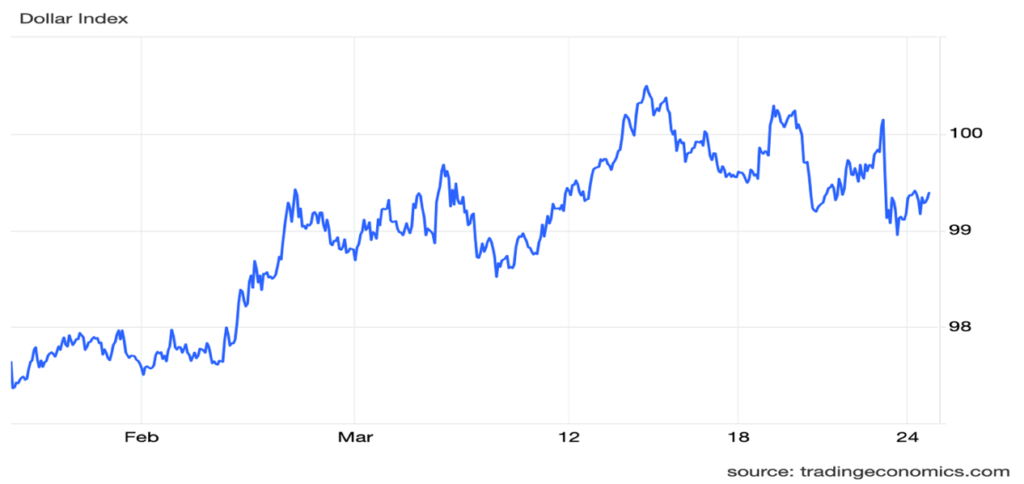
The dollar strengthening during a crisis is nothing new, but for it to appreciate while bonds and equities sell off is peculiar. Clearly what we witnessed was not a flight to safety in classic sense of international capital flows directed towards dollar securities, pivoting on the dollar’s international store of value function. It could, however, have been a dash for cash by global firms due to an interplay between the dollar’s role as means of account and means of payment in the world market. As oil and other commodities sharply appreciate, the assets and liabilities of internationally operative firms reprice. Higher oil and gas prices raise transaction demand among firms around the world for dollars as a means of payment; internationally operative financial institutions anticipate liquidity pressure and dash for dollar cash; and the result is dollar appreciation. Indicative evidence for this hypothesis is that asset managers were pivoting to cash at the fasted rate since March 2020, according to the March instalment of Bank of America’s global fund manager survey: respondents reported an increase in cash as a percentage of AUM from February’s 3.4% to 4.3% in March[30].
In this light, selloffs in US Treasuries are likely driven by central banks in energy-importing countries liquidating foreign exchange reserves to arrest the depreciation of their exchange rates[31]. As oil and gas reprice, energy importers must exchange more of their domestic currency for the dollars they need to pay exporters, increasing the supply of domestic currency relative to demand in forex markets, and the demand for dollars relative to supply. The flip side of the dollar appreciation we witnessed is a tendency for the currencies of energy importers to depreciate absent state intervention.
Figure 6
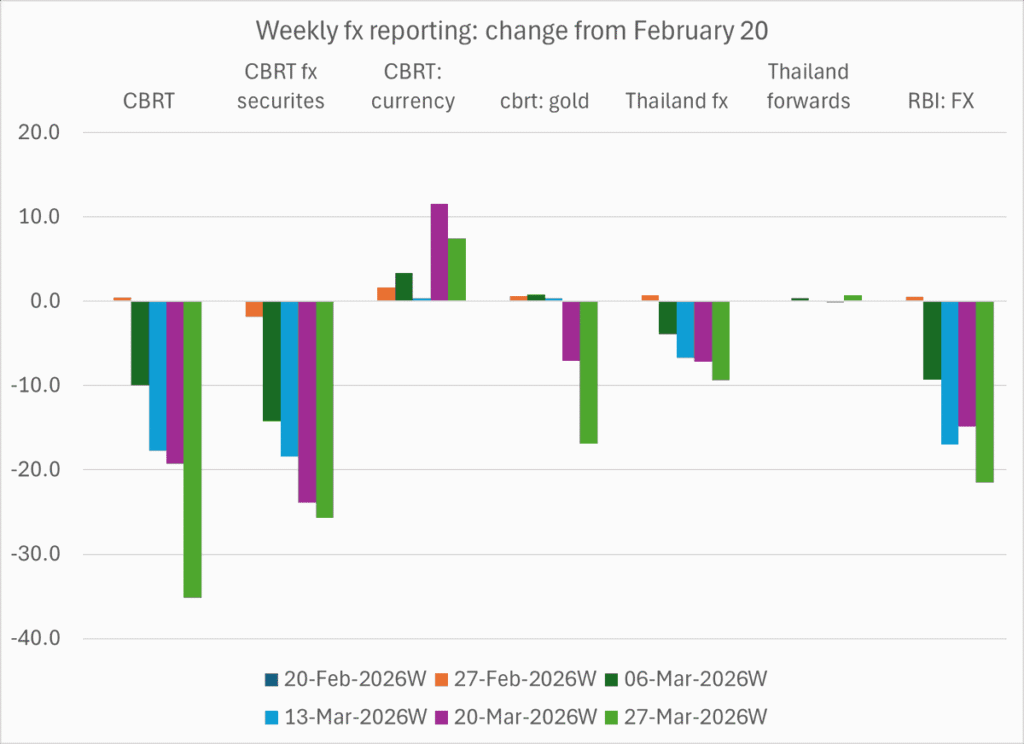
So the Americans have lurched headfirst into a gratuitous war, triggered an international crisis, yet the dollar strengthens. And far from US Treasury selloffs indicating withdrawal from the dollar system, they show just how imbricated the world market is within it. What dollar crisis?
How about petrodollar recycling? In the 1970s, this mechanism became a pillar of the American empire. Oil exporters earning vast dollar surpluses would recycle these into US assets, typically government bonds[33]. This would support the US balance of payments, given persistent current account deficits[34]. The surprising truth is that this mechanism attenuated before the conflict started. Figure 7 shows that with pre-war oil prices of $60-70/barrel, Saudi Arabia and Russia (the two largest oil exporters) did not enjoy large current account surpluses – the Russian surplus and Saudi deficit effectively cancelled out, and Russian oil and gas has been sanctioned since 2022 – and were therefore not net generating petrodollars.
Figure 7
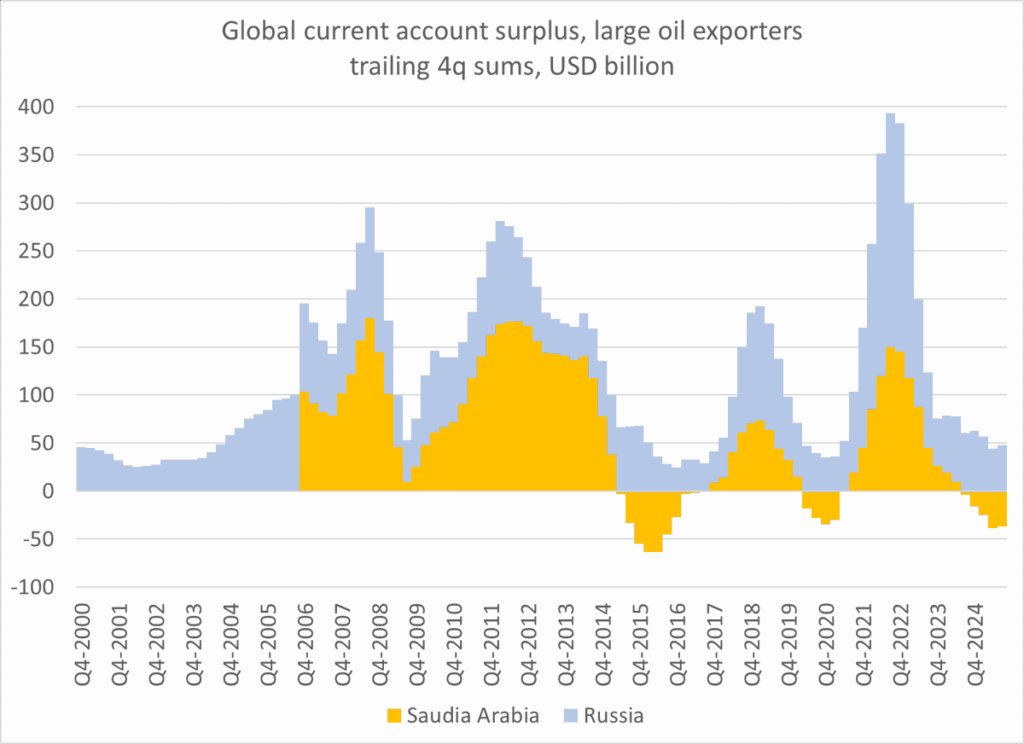
The same is true for the major Gulf oil exporters more broadly:
Figure 8
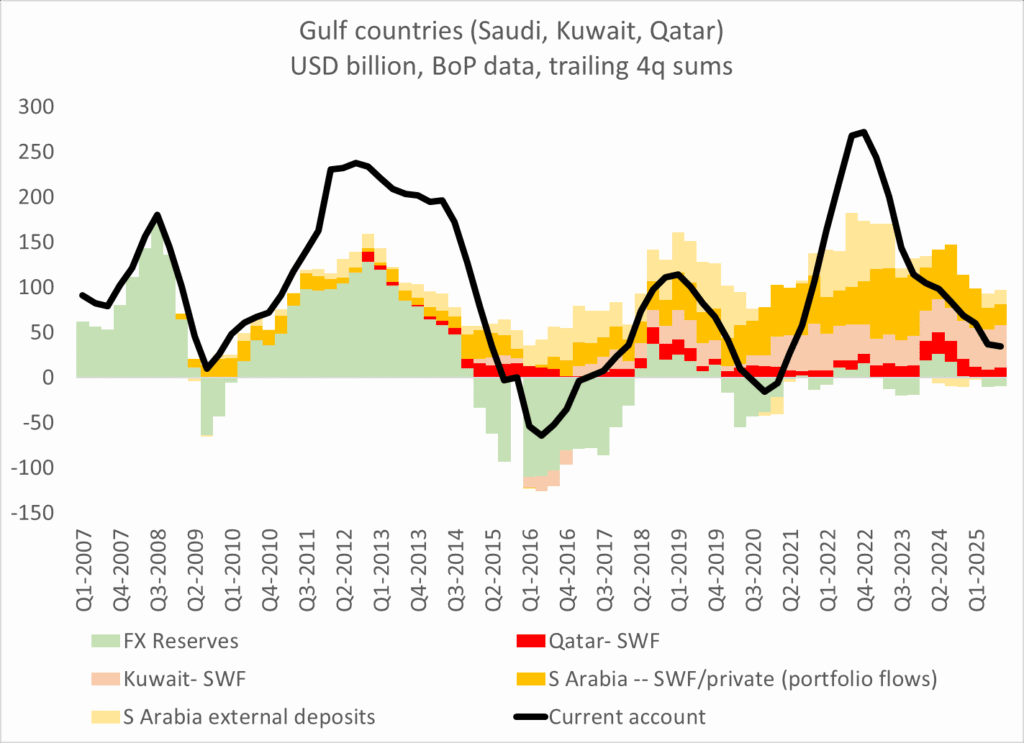
Moreover, whatever surpluses these countries had generated petrodollars less so in the typical sense of flows into US Treasuries; they increasingly generated petro-equities – flows into US public stocks and private equity (the latter through sovereign wealth funds):
Figure 9
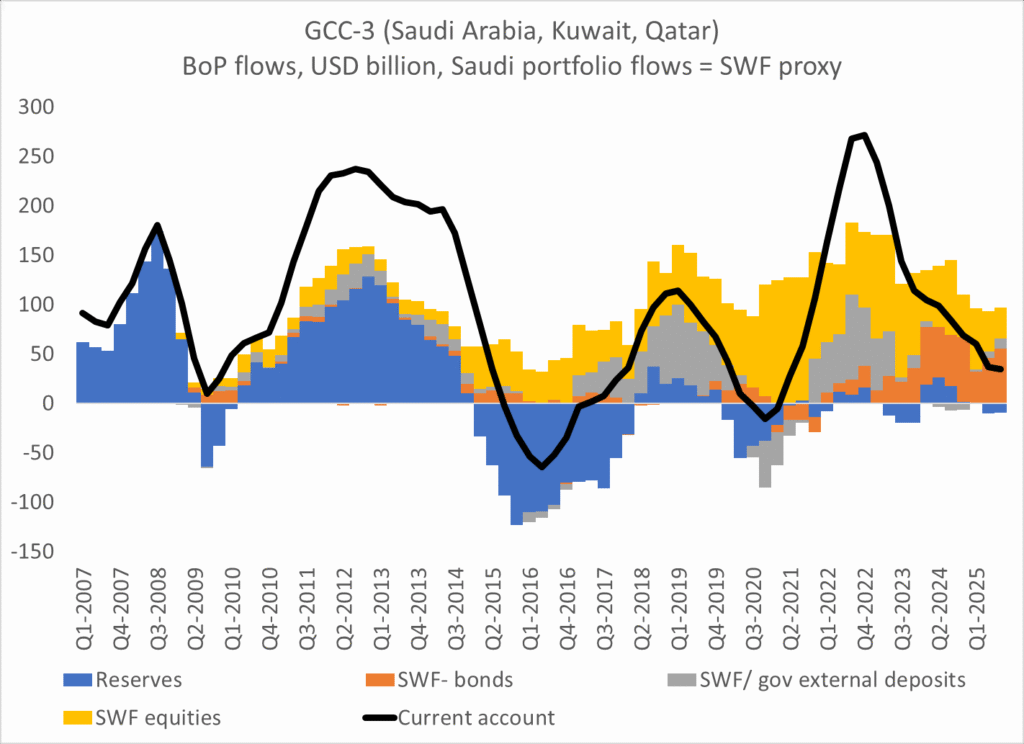
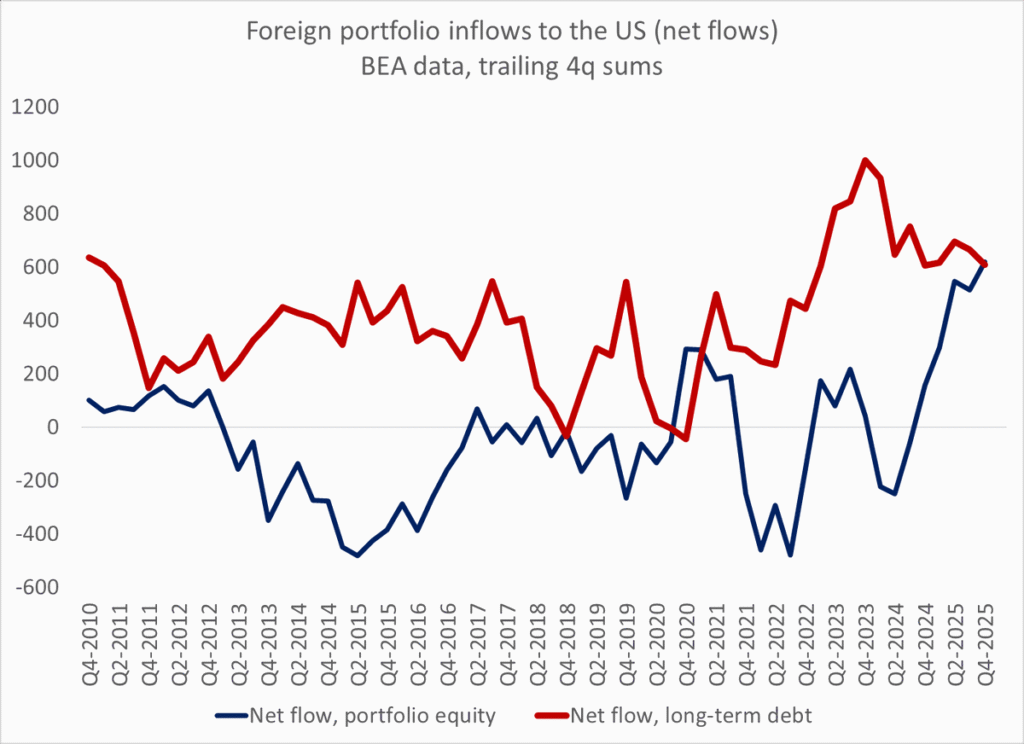
This is part of a broader trend – the US financial account increasingly relies on equity inflows[38]:
Figure 10
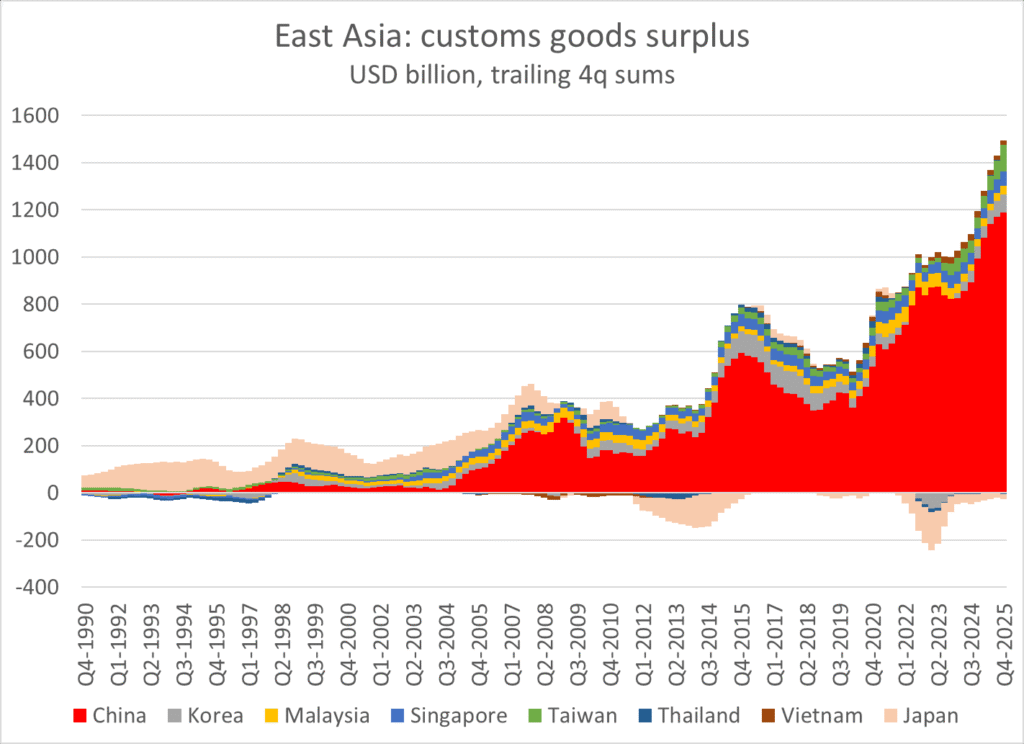
Prior to the war, the important surpluses originated in East Asia[40], particularly from China[41]:
Figure 11
Indeed, the East Asian surplus was far larger than the those from major oil exporting nations combined:
Figure 12
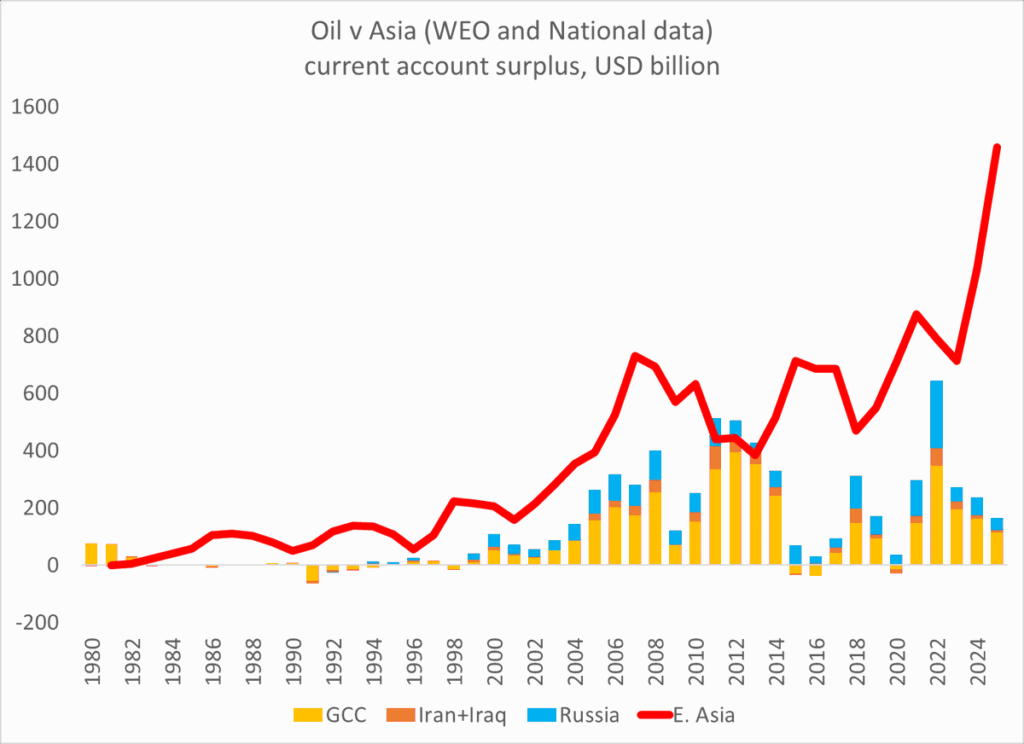
Today, petrodollars matter less to the US balance of payments than offshore East Asian surpluses in Eurodollar markets and domestic equivalents in state-owned banks. Surging oil and gas prices might not alter this equation, since major GCC producers still have their main export route shutdown and their infrastructure remains at risk of fresh military strikes. Russia could be a big winner, but it’s unlikely to generate many petrodollars[44]. These dynamics are particularly salient in the current moment because East Asian countries are highly dependent on oil and gas imports from the Persian Gulf. Table 2 illustrates this dependence for the three largest such economies.
Table 2: Proportion of Oil and Gas imports from the Middle East: China, Japan, S. Korea
| China | Japan | South Korea | |
| Proportion of oil imports from the Middle East | ~50% | ~95% | ~70% |
| Proportion of LNG imports from the Middle East | ~33% | ~11% | ~20% |
Whilst the spectre of a resumed conflict haunts the Persian Gulf, one cannot dismiss the possibility that oil and gas import-dependent nations experience supply shocks of the sort outlined in the previous section, potentially impacting their exports. A contraction of world trade and disruption to Eurodollar recycling is a greater threat to the US balance of payments than IRGC attacks on the petrodollar. An ameliorating factor is that a global trade contraction could improve the US current account by reducing imports. But this could easily be offset through another channel: the Trump administration is waging an expensive war and seeking to almost double military expenditure[46]; it is difficult to see how this wouldn’t increase the need for foreign capital inflows at a time of increasing scarcity. To paraphrase the adviser to the IRGC commander: “the Americans have debts of hundreds of billions of dollars, and they are thirsty for East Asian surpluses.”
Although centrifugal forces exist in the global dollar system, there are also counterbalancing centripetal forces (the dollar appreciated after all). It is therefore too early to start writing obituaries for dollar hegemony. So what would such pressure on the US balance of payments look like? – probably an uptick in domestic US interest rates, perhaps coinciding with inflationary waves that force the Fed into a tighter policy stance. But that’s not all. The main problem with this scenario is that the US is likely at the tail end of a credit cycle:
Figure 13
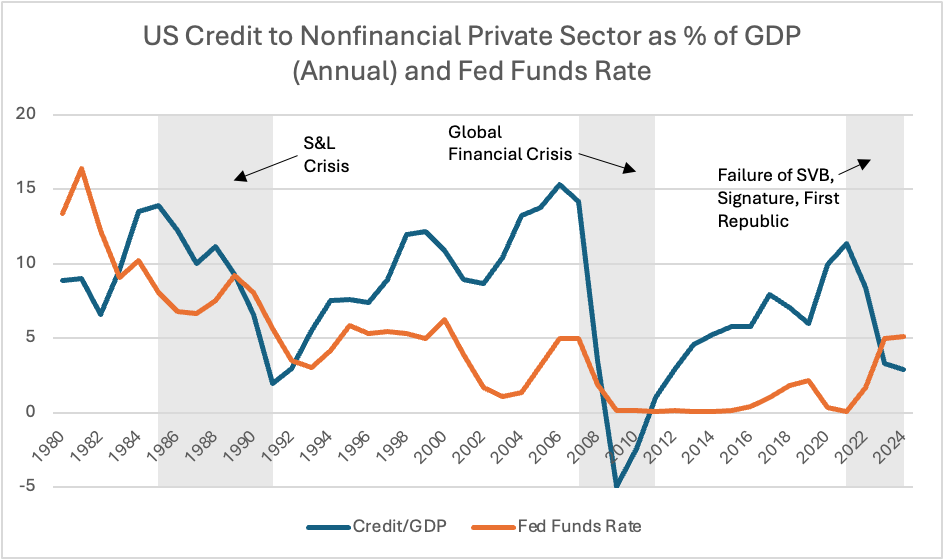
Figure 13 shows credit flows to the non-financial private sector as a share of GDP and the Fed funds rate. Notice that credit downturns coincide with the runups to and emergence of major financial crises, and that these are typically preluded or paralleled by interest rate hikes. Upturns in the cycle involve expanding credit flows and overextending balance sheets. But higher rates raise refinancing costs; credit growth slows and eventually collapses, with lenders deleveraging. Today there are widespread concerns about overinflated public and private equity and credit markets, particularly relating to the AI investment boom[48]. If the Gulf war shock precipitates higher interest rates in the US, the risks to financial stability will sharpen.
To summarise, the Iranians appear to be waging warfare on the financial arm of the American empire. Contemporary discourses centre the petrodollar as a weak node in the global dollar system, but these arguments are belied by the clear appreciation of the dollar after war began in oil-rich West Asia, and by the declining importance in recent years of petrodollar recycling to the US balance of payments. But the IRGC might be on to something in a roundabout way. There is a serious threat of global recession, especially if the war resumes. East Asian countries reliant on energy imports from the Persian Gulf are already being hit, with potentially severe consequences for their industrial and agricultural capacity, goods surpluses, and for the recycling of these into American assets. A combination of inflationary and balance of payments shocks would likely put upwards pressure on US domestic interest rates. And if they are indeed at the tail end of a credit cycle, the risks of financial crisis would intensify. Iranian hypersonic missiles might yet burst the asset bubbles on Uncle Sam’s frothy face.
Conclusion: Policy Constraints
Policy responses to the Covid crisis in the Global North were not easy, but they were feasible: vaccinate the population and end lockdowns; refloat businesses and households with vast expansionary fiscal and monetary policy, thereby reconstituting aggregate demand; and wait for supply chain bottlenecks to loosen. The inflationary shock did not hit immediately, so central banks initially cut rates and did enormous QE. We should remember, however, that once they began raising rates, it didn’t take long for cracks in the financial system to appear.
Responding to the current crisis could prove more challenging. Governments cannot print oil and gas. Whatever capacity is lost in the Persian Gulf will take a long time to reconstitute, with ripple effects across global supply chains. Price shocks are likely to be staggered and nonlinear, although they will hit many countries quickly. This is crucial because a protracted period of inflation will likely constrain monetary policy space. And should inflationary crises morph into stagflation, policy space would further tighten. This could even be true in the US, especially if contracting global trade at a time of elevated military expenditure puts pressure on its balance of payments. The risks are manifold, particularly if one thinks American asset markets are overheated.
Another consideration is that many countries have enormous sovereign debts. Rising interest rates increase debt serving costs; the limits to how high these payments can go as a share of government revenues is unclear – but there are limits. What if governments in the Global North decide to cut rates and rollout QE? This would be a novel response to an inflationary crisis and could juice asset markets. It might happen, but the ability of governments to do so would surely depend on their trade and fiscal balances, and the health of their financial systems. There are no easy solutions. States may find themselves stuck between a rock and hard place – between a Blackrock and a Hormuz Strait.
[1] https://www.iea.org/about/oil-security-and-emergency-response/strait-of-hormuz
[2] www.carlyle.com/carlyle-compass/you-cant-print-molecules
[3] https://www.eiu.com/n/financial-services-chart-of-the-week-war-risk-premiums-surge/
[4] IEA Oil Market Report, March 2026, pg. 20: https://iea.blob.core.windows.net/assets/a25ddf53-cd6c-4910-ac90-16bfd28399e7/-12MAR2026_OilMarketReport.pdf.
[5] https://www.reuters.com/business/energy/iran-attack-damage-wipes-out-17-qatars-lng-capacity-three-five-years-qatarenergy-2026-03-19/
[6] IEA Oil Market Report, March 2026, pg. 1: https://iea.blob.core.windows.net/assets/a25ddf53-cd6c-4910-ac90-16bfd28399e7/-12MAR2026_OilMarketReport.pdf.
[7] Martin Wolf, March 18 2026, “Trump has broken it. Now he owns it”: https://www.ft.com/content/86be5097-1a9c-4dd6-bf53-1f2b429592c7?syn-25a6b1a6=1
[8]More than 85% of energy for industrial process heating comes from natural gas, coal, and oil boilers: https://www.mckinsey.com/industries/industrials/our-insights/industrial-heat-pumps-five-considerations-for-future-growth
[9] https://www.carlyle.com/global-insights/white-paper/a-crude-awakening-pdf
[10] https://www.energypolicy.columbia.edu/us-israeli-attacks-on-iran-and-global-energy-impacts/#what_effect_will_the_middle_east_conflict_have_on_commodities_beyond_oil_and_gas
[11] https://www.lloydslist.com/LL1156586/Gulf-war-risk-premiums-topping-double-digit-millions-of-dollars-per-trip
[12] https://www.lloydslist.com/LL1147965/Red-Sea-war-risk-rates-see-huge-jump-in-wake-of-Yemen-airstrikes
[13] https://www.carlyle.com/carlyle-compass/you-cant-print-molecules
[14] https://www.iata.org/en/publications/economics/fuel-monitor/
[15] For instance, Canada has substantial sulphur stocks, with major sources of industrial demand as far away as China: https://www.energypolicy.columbia.edu/us-israeli-attacks-on-iran-and-global-energy-impacts/#what_effect_will_the_middle_east_conflict_have_on_commodities_beyond_oil_and_gas; https://www.ft.com/content/dd2498cc-d221-4645-9fae-34d1d832c15d?syn-25a6b1a6=1
[16] https://www.reuters.com/business/energy/chinas-fuel-export-ban-further-tighten-asia-supply-2026-03-17/
[17] https://www.reuters.com/world/asia-pacific/china-restricts-fertiliser-exports-further-crimping-war-tightened-supply-2026-03-19/
[18] https://www.bloomberg.com/news/articles/2026-03-04/putin-says-russia-to-weigh-redirecting-gas-supplies-away-from-eu
[19] https://www.reuters.com/business/energy/russia-may-ban-some-fuel-exports-case-high-prices-energy-ministry-official-says-2026-03-19/
[20]https://www.ft.com/content/a492b155-d8c4-4c7d-93ab-6a0d40e74489?syn-25a6b1a6=1
[21] Emphasis added; https://www.premiumtimesng.com/news/headlines/860967-us-israel-iran-war-day-4-trump-says-war-to-last-4-5-weeks-wont-rule-out-ground-troops.html
[22] https://www.reuters.com/world/middle-east/gulf-banks-face-307-billion-deposit-flight-risk-if-war-drags-sp-says-2026-03-17/
[23] https://www.bloomberg.com/news/articles/2026-03-08/kuwait-pension-fund-hq-airport-hit-in-overnight-drone-attacks
[24] https://x.com/mb_ghalibaf/status/2035776169656676675
[25] https://edition.cnn.com/world/trump-china-iran-oil-analysis-intl-hnk
[26] www.atlanticcouncil.org/blogs/econographics/is-the-end-of-the-petrodollar-near/
[27] Boz et al., 2025: https://www.elibrary.imf.org/view/journals/001/2025/178/001.2025.issue-178-en.xml?cid=lk-com-dsp-imf.org
[28]Ibid.
[29] Trading Economics DXY spot price index, 24/03/2026: https://tradingeconomics.com/dxy:cur
[30] https://www.morningstar.com/news/marketwatch/2026031734/fund-managers-increased-their-cash-reserves-at-the-outset-of-war-by-the-most-since-covid-emerged
[31] https://www.ft.com/content/1c4189e9-36af-4779-b862-d868cf2aff76?syn-25a6b1a6=1
[32] CBRT is the Central Bank of the Republic of Türkiye and RBI is the Reserve Bank of India: https://x.com/Brad_Setser/status/2040102856586314190
[33] https://www.carlyle.com/global-insights/white-paper/a-crude-awakening-pdf
[34] Persistent albeit not continuous over the last half century.
[35] Brad Setser: https://x.com/Brad_Setser/status/2035697952748892458?s=20
[36] Brad Setser: https://x.com/Brad_Setser/status/2035703241942392891?s=20
[37] Brad Setser: https://x.com/Brad_Setser/status/2035700080489955521?s=20
[38] This is noteworthy, if one thinks that US public and private equity markets are overinflated, and that the war might trigger a reversal of these flows.
[39] Brad Setser: https://x.com/Brad_Setser/status/2036829486574936529?s=20
[40] European surpluses have become less relevant since 2022, when the Germans committed hara-kiri by acquiescing to American demands to sanction the cheap Russian gas their industrial base relied upon.
[41] Customs surplus = value of exported goods – value of imported goods based on customs data: https://www.banque-france.fr/en/publications-and-statistics/publications/how-big-chinas-trade-surplus
[42] Brad Setser: https://x.com/Brad_Setser/status/2035707266159022292?s=20
[43] Brad Setser: https://x.com/brad_setser/status/2036543259023995214?s=48
[44] Boz et al. 2025: https://www.elibrary.imf.org/view/journals/001/2025/178/article-A001-en.xml
[45] https://www.reuters.com/business/energy/asias-oil-lng-dependence-middle-east-2026-03-02/
[46] https://www.washingtonpost.com/opinions/2026/03/21/iran-war-supplemental-munitions-military-budget/
[47] Credit is the first difference of private sector debt; authors calculations, BIS, BEA, and FRED data.
[48] There are substantial risks on both sides of this bet, the details of which are beyond the scope of this work.